

The night sky has long captivated humanity, serving as a canvas for stories, navigation, and inspiration. Among the myriad ways to connect with the cosmos, personalized constellation gifts have emerged as a unique and meaningful way to celebrate special moments and relationships. These gifts, which range from star maps to jewelry and home décor, encapsulate specific celestial alignments tied to significant dates and locations. Far beyond mere aesthetics, they weave together astronomy, emotion, and artistry, offering a tangible connection to the universe. This article delves into the history, current landscape, key concepts, benefits, challenges, and future trends of personalized constellation gifts, providing an in-depth exploration for enthusiasts and newcomers alike.
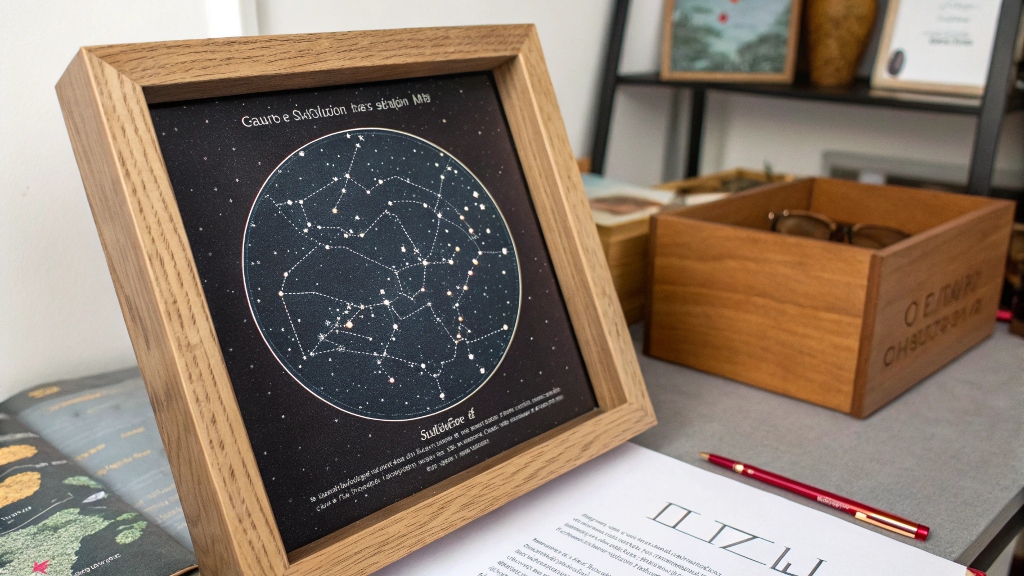
The History of Constellation-Based Gifts
Ancient Roots of Stargazing and Gifting
The practice of looking to the stars for meaning predates recorded history, with constellations serving as cultural touchstones across civilizations.
-
Mesopotamian Origins: Around 3000 BCE, Mesopotamians cataloged stars, creating early constellations that influenced later Greek and Roman systems.
-
Cultural Significance:
-
In Ancient Egypt, stars guided religious rituals and agricultural cycles.
-
Indigenous cultures, such as the Navajo, used constellations to tell stories and mark seasonal changes.
-
-
Gifting Traditions: Early gifts tied to the stars included amulets and carvings inscribed with celestial symbols, often bestowed for protection or to mark significant events like births or marriages.
The Evolution of Personalized Celestial Gifts
The modern concept of personalized constellation gifts emerged with advancements in astronomy and printing technology.
-
19th Century Star Charts: The development of accurate star atlases allowed individuals to map the night sky for specific dates, laying the groundwork for custom star maps.
-
20th Century Commercialization:
-
Companies began offering star-naming services in the 1980s, though these were not officially recognized by astronomical bodies like the International Astronomical Union (IAU).
-
Early personalized gifts included engraved jewelry with zodiac signs or constellation patterns.
-
-
Digital Revolution: The advent of software in the late 20th century enabled precise calculations of celestial positions, making personalized star maps widely accessible.
The Current State of Personalized Constellation Gifts
Types of Personalized Constellation Gifts
Today, the market for personalized constellation gifts is diverse, catering to varied tastes and budgets.
-
Custom Star Maps:
-
Printed or digital representations of the night sky on a specific date, time, and location.
-
Options include minimalist designs, watercolor styles, or 3D renderings.
-
-
Jewelry:
-
Necklaces, bracelets, and rings featuring constellation patterns or star coordinates.
-
Materials range from sterling silver to gold, often with gemstone accents.
-
-
Home Décor:
-
Wall art, lamps, or blankets embroidered with star maps or constellations.
-
Interactive options like LED-lit maps that glow in the dark.
-
-
Digital and Experiential Gifts:
-
Virtual reality (VR) experiences simulating the night sky of a chosen moment.
-
Mobile apps that generate real-time star maps with augmented reality (AR) overlays.
-
Market Trends and Consumer Preferences
The demand for personalized constellation gifts has surged, driven by a desire for unique, sentimental presents.
-
Growth Statistics:
-
The global personalized gift market was valued at $26.3 billion in 2022, with celestial-themed gifts contributing significantly.
-
Online platforms like Etsy and specialized retailers report a 15% annual increase in star map sales since 2018.
-
-
Demographics:
-
Popular among millennials and Gen Z, who value experiences and meaningful connections.
-
Frequently purchased for anniversaries, weddings, births, and memorials.
-
-
Customization Options:
-
Consumers can choose colors, fonts, and add personal messages or coordinates.
-
Some companies offer dual-date maps to compare skies from two significant moments.
-
|
Gift Type |
Price Range |
Customization Options |
Popular Occasions |
|---|---|---|---|
|
Custom Star Map |
$20–$150 |
Design style, colors, text, frame |
Anniversaries, Weddings |
|
Constellation Jewelry |
$30–$500 |
Material, gemstones, engraving |
Birthdays, Graduations |
|
Celestial Home Décor |
$50–$300 |
Size, material, lighting features |
Housewarmings, Memorials |
|
Digital/Experiential |
$10–$100 |
AR/VR compatibility, subscription-based access |
Engagements, Unique Gifting |
Key Concepts Behind Personalized Constellation Gifts
Astronomical Foundations
Creating a personalized constellation gift requires precise astronomical calculations.
-
Celestial Coordinates:
-
Right Ascension (RA) and Declination (Dec) pinpoint star positions.
-
Software like Stellarium or proprietary algorithms calculates star positions for any date and location.
-
-
Precession and Time:
-
Earth’s axial precession shifts constellations over millennia, requiring adjustments for historical or future star maps.
-
Example: A star map for 2000 BCE would differ significantly from one for 2025 due to this shift.
-
-
Light Pollution and Visibility:
-
Urban areas obscure fainter stars, so maps often prioritize bright stars or offer “ideal sky” views.
-
Some providers include an option to simulate light pollution levels for authenticity.
-
Emotional and Symbolic Significance
The power of these gifts lies in their ability to evoke emotion and tell personal stories.
-
Milestone Markers:
-
A star map from the night of a wedding symbolizes enduring love.
-
A map marking a child’s birth captures a moment of new beginnings.
-
-
Universal Connection:
-
Stars transcend cultural and geographic boundaries, making these gifts universally relatable.
-
They evoke a sense of wonder, reminding recipients of their place in the cosmos.
-
-
Memorialization:
-
Gifts commemorating loved ones often feature the sky on the date of their passing, offering comfort and connection.
-
Benefits of Personalized Constellation Gifts
Emotional Impact
These gifts resonate deeply due to their personal and universal appeal.
-
Sentimental Value:
-
Recipients often describe feeling “seen” and valued when receiving a gift tied to a specific moment.
-
Example: A couple receiving a star map of their first date may feel a renewed sense of connection.
-
-
Lasting Memories:
-
Unlike flowers or consumables, star maps and jewelry are durable keepsakes.
-
Many become family heirlooms, passed down with their stories.
-
Educational Value
Personalized constellation gifts can spark interest in astronomy and science.
-
Learning Opportunities:
-
Recipients may explore constellations or use apps to locate stars from their map in the real sky.
-
Some gifts include guides to prominent stars or constellations visible on the chosen date.
-
-
STEAM Engagement:
-
For children, these gifts can inspire curiosity in science, technology, engineering, arts, and math.
-
Example: A star map gift for a child’s birthday might lead to a hobby in stargazing.
-
Versatility and Accessibility
The wide range of products ensures something for every budget and preference.
-
Affordability:
-
Digital star maps start at $10, while high-end jewelry can cost hundreds.
-
DIY options, like using free astronomy software, make the concept accessible to all.
-
-
Global Appeal:
-
Available online, these gifts can be shipped worldwide or delivered digitally.
-
Language options and universal symbols make them inclusive.
-
Challenges in the Personalized Constellation Gift Industry
Accuracy and Authenticity
Ensuring astronomical precision is critical but challenging.
-
Calculation Errors:
-
Inaccurate software or user-input errors (e.g., wrong date or location) can result in incorrect star maps.
-
Solution: Reputable companies use verified algorithms and offer previews before finalizing.
-
-
Star-Naming Controversies:
-
Some companies sell “star-naming” services, misleading customers into thinking they’ve officially named a star.
-
The IAU is the only body authorized to name celestial objects, and it does not endorse commercial naming.
-
Market Saturation and Quality Control
The popularity of these gifts has led to a crowded market.
-
Low-Quality Products:
-
Some vendors use cheap materials or generic designs, reducing the gift’s impact.
-
Example: Faded prints or poorly engraved jewelry can disappoint recipients.
-
-
Consumer Confusion:
-
With countless online retailers, distinguishing reputable sellers from low-quality ones is difficult.
-
Solution: Look for reviews, certifications, or partnerships with astronomers.
-
Environmental Concerns
The production and shipping of physical gifts raise sustainability issues.
-
Material Waste:
-
Non-recyclable frames or packaging contribute to environmental impact.
-
Solution: Some companies offer eco-friendly options, like recycled paper or sustainable wood.
-
-
Carbon Footprint:
-
Global shipping increases emissions, especially for rush orders.
-
Digital gifts or local artisans can reduce this impact.
-
Future Trends in Personalized Constellation Gifts
Technological Advancements
Emerging technologies are enhancing the personalization and interactivity of these gifts.
-
Augmented Reality (AR):
-
AR apps allow users to point their phone at a star map and see an animated sky with constellation overlays.
-
Example: A gift might include a QR code linking to an AR experience of the chosen night sky.
-
-
3D Printing:
-
Custom 3D-printed models of constellations or star maps are gaining traction.
-
These can be tactile gifts for visually impaired recipients or interactive décor.
-
-
AI-Driven Customization:
-
AI could analyze user preferences to suggest designs or highlight meaningful celestial events (e.g., a meteor shower on the chosen date).
-
Cultural and Artistic Integration
The aesthetic and cultural dimensions of these gifts are evolving.
-
Indigenous Constellations:
-
Some companies are incorporating non-Western constellations, such as those from Aboriginal Australian or Polynesian traditions.
-
This promotes cultural diversity and educates recipients about global stargazing traditions.
-
-
Collaborations with Artists:
-
Limited-edition star maps designed by renowned artists are becoming collector’s items.
-
Example: A watercolor star map by a local artist adds a unique, handmade touch.
-
Experiential Gifting
The focus is shifting toward experiences that complement physical gifts.
-
Stargazing Events:
-
Some retailers partner with observatories to offer guided stargazing sessions tied to the gift’s date.
-
Example: A couple receives a star map and tickets to a planetarium show recreating their night sky.
-
-
Virtual Reality Experiences:
-
VR headsets can simulate the exact sky from a chosen moment, complete with narration or music.
-
These are ideal for remote gifting or recipients in light-polluted areas.
-
Proven Methodology: Creating a Personalized Star Map
To illustrate the process, here’s a step-by-step guide to creating an accurate star map, grounded in astronomical principles.
-
Choose the Date and Time:
-
Select a significant moment (e.g., June 15, 2023, at 9:00 PM).
-
Ensure the time is in the local timezone of the event.
-
-
Determine the Location:
-
Input precise coordinates (latitude and longitude) for accuracy.
-
Example: New York City is approximately 40.7128°N, 74.0060°W.
-
-
Calculate Celestial Positions:
-
Use software to compute star positions, accounting for precession and proper motion.
-
Formula: RA and Dec are derived from equatorial coordinates, adjusted for the observer’s location and time.
-
-
Select Visible Stars:
-
Filter stars by magnitude (brightness) to ensure visibility.
-
Typical threshold: Magnitude 6 or brighter for naked-eye visibility.
-
-
Design the Map:
-
Choose a style (e.g., minimalist, vintage) and add custom text or colors.
-
Verify the map with a preview to ensure accuracy.
-
-
Produce the Gift:
-
Print on high-quality paper, engrave on jewelry, or render digitally.
-
Include a certificate of authenticity or explanation for the recipient.
-
Mathematical Example: To calculate a star’s position, use the sidereal time formula: [ \text{Local Sidereal Time (LST)} = \text{Greenwich Sidereal Time (GST)} + \text{Longitude} \times \frac{24}{360} ] For a star at RA = 5h 32m 12s, visible when LST matches RA, the map ensures the star is correctly placed relative to the observer’s horizon.
Read More Also: Personalized Gifts for Small Business Owners
Review: Why Personalized Constellation Gifts Shine
Personalized constellation gifts stand out for their blend of science, sentiment, and artistry. They transform a universal phenomenon—the night sky—into a deeply personal keepsake. Their versatility, from affordable digital maps to luxurious jewelry, ensures accessibility for all. However, challenges like market saturation and accuracy concerns require consumers to choose reputable providers. As technology advances, these gifts are becoming more interactive and culturally diverse, promising an exciting future. For those seeking a gift that transcends the ordinary, personalized constellation gifts offer meaning that truly reaches beyond the stars.
Read More Also: Unique Hostess Gifts Under $30: A Comprehensive Guide
FAQs: Short and Insightful Answers
What is a personalized constellation gift?
A gift, like a star map or jewelry, depicting the night sky or constellations for a specific date, time, and location, tailored to a meaningful event.
Are star-naming services legitimate?
No, commercial star-naming is not recognized by the IAU, the only authority for naming celestial bodies. Opt for star maps or coordinates for authenticity.
How accurate are custom star maps?
High-quality maps use precise astronomical software, but accuracy depends on correct date, time, and location inputs. Always verify with a preview.
Can I create a star map myself?
Yes, using free software like Stellarium or online tools. Input your date, time, and coordinates, then customize the design for printing or digital use.
What’s the best occasion for a constellation gift?
They’re ideal for anniversaries, weddings, births, or memorials, but their versatility suits any milestone where the night sky holds significance.